
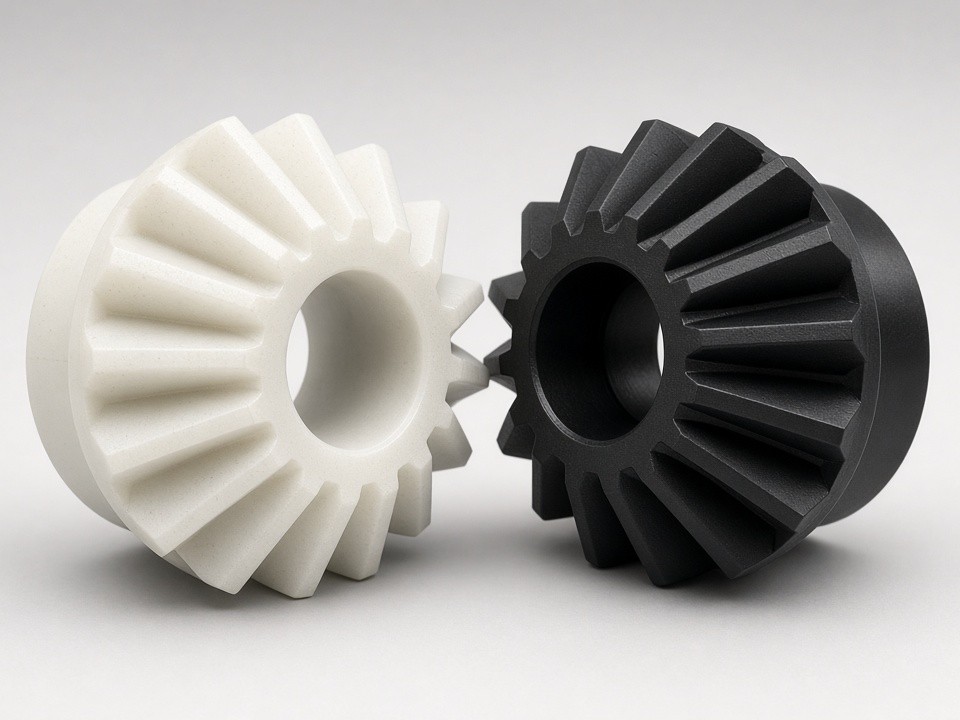
Bevel Gears
Conical gears for intersecting shafts—typically 90°. Useful in right-angle gearboxes, hand tools, and robot wrist mechanisms.
Request QuoteBuyer use cases for bevel & miter gears
Right-angle gearboxes
1:1 miters and reduction bevels for compact envelopes—quote both members together so backlash and cone distance stay consistent.
Robot wrist & EOAT
Intersecting-axis drives in lightweight aluminum or steel; we hold hub and bore so encoder stacks build cleanly.
Hand tools & fixtures
Durable bevel sets for manual and semi-auto tools where catalog miters don’t match your shaft spacing.
Packaging machinery
Change-of-direction stages without committing to a full worm set—good when efficiency matters more than self-locking.
Lab & test equipment
Quiet plastic bevels for light-duty instruments; steel when the test stand sees real torque.
Conveyor transfers
90° power take-offs on plant-floor equipment—practical tolerances, replaceable as a matched pair.
Agricultural & outdoor implements
Stainless or coated steel bevels when moisture and grit are part of the duty cycle.
Obsolete OEM replacements
Reverse-engineer a worn bevel set from samples when the catalog part is discontinued.
DFM tips for bevel gears
- •Call out shaft angle (usually 90°), tooth count on both members, module, and cone distance clearly on one drawing package.
- •Order mating gears as a pair when backlash and contact pattern matter—cutting them separately weeks apart is how assemblies get noisy.
- •Leave stock for bore finishing after tooth cutting if heat treat is required; soft-finished bores can move.
- •Define mounting distance / apex location; bevel mesh is sensitive to how deep the gear sits on the shaft.
- •For miter (1:1) sets, confirm both blanks use the same material and heat-treat path so wear rates match.
- •If you only know ratio and center/shaft geometry, send a sketch—we’ll help translate into tooth counts before cutting.
Bevel gear specs we quote to
Pair inspection
- ✓Tooth counts and module confirmed on both members before ship.
- ✓Bore and hub dimensions checked to the print; mounting distance notes included when specified.
- ✓Deburr and edge quality on tooth toes/heels—common chip sites on bevels.
- ✓Optional blue-contact pattern check when you order a development pair for a new housing.
Lead time for matched pairs
Plan a bit more schedule than a simple spur: both members share blanking and tooth ops. Prototype pairs often land in the 1–2 week range after DFM when stock is available; heat treat and specialty materials stretch that. Ask for a paired ship date so you don’t wait on the second gear.
Bevel gear FAQ
Do you make spiral bevel or hypoid gears?
We focus on straight bevel and miter gears for custom and low-volume export work. Spiral/hypoid often need specialized equipment—tell us the requirement and we’ll say clearly whether we can cut it or should help you redesign to straight bevel.
Can one bevel be plastic and the mate steel?
Sometimes, for noise or sacrificial wear. We’ll check load and duty first—mismatched materials change wear and backlash over time.