
Mill-Turn CNC Services
Partsproto machines parts that need both turned diameters and milled features without stacking multiple fixtures. Mill-turn (multitasking) centers finish shafts with flats, ports, and off-axis holes in fewer setups—better concentricity, fewer hand-offs, clearer export pricing.
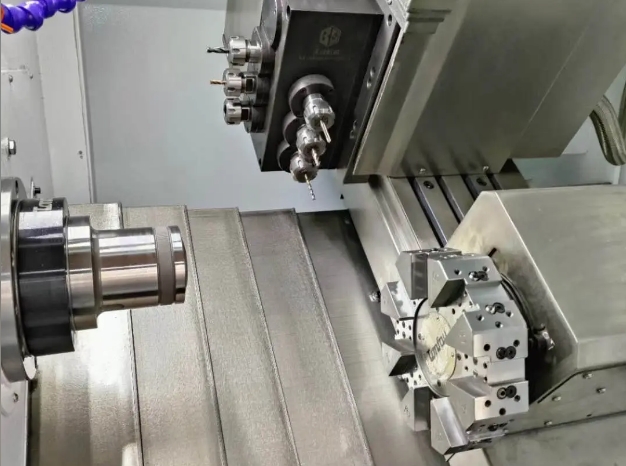
Mill-turn capabilities
Multitasking envelope
Turning with live tooling and multi-axis milling on rotational work
- •Typical OD range: ~Ø3–650 mm (confirm per machine)
- •Length: up to ~1500 mm depending on diameter & support
- •Live tooling + sub-spindle options for complete both ends
Feature mix we quote
What mill-turn is built for
- •OD/ID turning, grooves, threads
- •Cross-holes, flats, hexes, keyways
- •Angled ports and light prismatic milling
Practical precision
Tolerances depend on feature and material—quoted honestly
- •Positional: often ±0.01 mm when process-fit
- •Turned diameters: ±0.02 mm typical default
- •Surface: Ra 0.4–3.2 μm as process allows
Materials fit for mill-turn
Process steps buyers should expect
RFQ intake
STEP/PDF, material, qty, CTQ notes, finish, ship-to country.
Capability match
We confirm mill-turn envelope vs Swiss vs 5-axis and quote the fit.
Setup & FA
Workholding and tool list locked; first article approved against print.
Lot run
Bar or chuck production with in-process checks on CTQs.
Finish & ship
Deburr, secondary finish, inspect, pack for export.
What mill-turn is—and when to choose it
Mill-turn combines lathe spindles with live tooling and often a B-axis or sub-spindle so you can turn, drill, mill, and sometimes finish both ends in one clamping family. That protects datum relationships between turned and milled features.
Choose mill-turn when a part is mostly rotational but carries flats, hexes, cross-ports, angled holes, or light prismatic pockets that would otherwise force a second mill setup and stack-up risk.
If the part is almost entirely prismatic, 3-/5-axis milling is usually better. If it is a slender small-diameter pin with light secondary features, Swiss may win. We will pick the cheaper capable path on the quote—Partsproto is a China export shop, not a process dogma shop.
- → Shafts or fittings with flats, keyways, ports, or milled pockets
- → Concentricity between OD and milled features is a CTQ
- → You want fewer fixtures and cleaner unit price at 50–5,000 pcs
- → Both ends need work and sub-spindle transfer makes sense
DFM tips for mill-turn parts
- •Define one primary turned datum axis; relate milled ports and flats to that axis so we can hold position without heroic fixturing.
- •Keep wrench flats and hexes at standard sizes when possible—special sizes need custom tooling or slower milling.
- •Deep cross-holes intersecting thin walls: add local boss thickness or we will flag leak/strength risk in DFM.
- •Call out which end is finished first if both ends have critical features; sub-spindle transfer needs a clear grip plan.
- •Do not over-tolerance non-functional OD tapers; put the money on seal diameters and port positions.
- •If anodize or plating is required, tell us masking needs early—mill-turn parts often have threads and seals that must stay clean.
Inspection & QC
- ✓Turned CTQ diameters and lengths on first article and patrol samples.
- ✓Positional checks on milled flats, ports, and cross-holes vs turned datum.
- ✓Thread gauges / optical thread check as specified.
- ✓Optional CMM for complex port patterns or GD&T frames.
- ✓Material certs and finish certs when ordered with the lot.
Lead time & batch sizing
First articles on straightforward aluminum mill-turn parts often land in about 7–12 working days after DFM and material readiness. Stainless and complex port patterns take longer. Repeating lots of 50–500 usually reuse the same program and fixtures—ask for 1 / 25 / 100 / 500 break points. Large export programs can lock a process sheet, AQL plan, and buffer stock agreement on the PO.
Mill-turn FAQ for RFQs
Mill-turn vs separate lathe + mill—when do I save money?
When milled features must stay true to turned diameters, or when qty is high enough that one multitasking cycle beats two setups. Low-qty simple shafts with one flat may still be cheaper as lathe + secondary mill.
What is the difference between mill-turn and 5-axis?
Mill-turn is optimized for rotational primary geometry. 5-axis milling is for prismatic or freeform parts that are not mainly spun. Some parts could go either way—we quote the lower-risk capable option.
Can you do both ends complete?
Often yes with sub-spindle transfer. Very long or fragile parts may need steady rest or a split process—we will say so in DFM.
What should be on my RFQ to avoid delay?
STEP + PDF, material/temper, quantity breaks, finish, CTQ list, and whether ports are pressure-critical. Photos of a sample help if drawings are incomplete.
Do you support overseas buyers from China?
Yes. Partsproto machines in China and ships export lots with packing lists, certs, and dimensional reports as ordered.
What batch sizes make sense?
Prototypes (1–10), pilots (25–100), and production (hundreds to thousands). Unit price drops when setup is shared—request break-point quotes.
Ready to quote mill-turn parts?
Send your rotational + milled print set. Partsproto replies with process choice, price breaks, and a realistic export ship window.